Thursday, 30 September 2021

Knopper Galls, Georgina and Automotive Eau

Hello, Hello, 

In the face of further production cuts and ongoing transport difficulties it now appears that this once bi weekly production of guff has now morphed into a monthly affair. 

Apologies

The purchase price however remains the same. 

It’s just that I’ve had a lot on of late with the allotment. Potatoes are in sacks, many beans are in the freezer along with a smaller crop of tomatoes than I anticipated (damn you potato blight) and a big bag of frozen sweetcorn cobs. My shed carries the fragrance of the inside of an onion as two hundred and fifty six of the things hang on their ropes and cabbages, sprouts, leeks, swede and celeriac await their arrival in the vegetable spotlight. 

I’ve a cupboard full of pickles. From red cabbage through cornichons to Delia Smith’s runner bean pickle. 

Oh yes the river. 

The trout season is drawing to a close. Fishing picked up a little in September with a few fish falling to sedges, emergers and daddy long legs. The weed is in decline and has been pulled out in a few places by the reasonable flow which has caused the level to drop. Swallows exited stage left a few weeks ago although Madam and myself did see a few martins as we walked along a stretch of the upper Test in our efforts to prolong life. 

It’s a walk we always do in the Autumn as there is a superb spot for picking mushrooms, the location of which, if revealed on here would require the reader to print off this text and eat the evidence. 

A mushroomer never reveals his source, and we often take an indirect route to the field to throw off anyone who may be tracking our movements by way of gaining access to this fungal trove. 

Our home environs has also experienced a bumper crop of knopper galls.
A peculiar mutation that engulfs an acorn, it is caused by the gall wasp that lays its eggs in the acorn causing the mutation to the knopper gall. The tree remains unharmed by the wasp, but it seems that brer gall wasp has had quite a good year. 

I’ve also been at all the hedges with the pole trimmer (rechargeable, we're saving the planet here) and at this point could I make my annual case for the future of boundary demarcation to be fences and walls. I was a physical wreck after a week cutting these clipped arboreal leviathans, they seem to have grown more than ever this summer. 

I was kindly invited up to Scotland to fish the Tay for a few days in the name of bothering Salmo Salar. 

Murthly to be precise and the stretch where in 1922 Georgina Ballantine landed what is still the UK record salmon of 64lb. She fished and lived with her father in the little cottage by the river at the end of Caputh bridge. The fish took over two hours to land and was a few inches short of six feet long. A cast of the fish was made and can still be seen in the museum in Perth. After the cast had been taken the fish was presented to Perth hospital where all staff and patients dined on fresh salmon for a few days. 

She became quite an angling celebrity, however the captor of the largest salmon ever caught in the UK was denied membership to the Fly Fishers Guild because she was not a man.
 

It was the 1920's.... nuff said. 

Well done Emmeline for all you did, well done.

Anyway the Tay has experienced low levels all summer. 

It has been quite dry in the region for months, however our arrival was marked by eighteen hours of rain, a four foot rise in river level and all manner of rubbish riding down the river. 

On our last day I did manage to land a fish, that I had as over eighteen pounds but Donald the ghillie had around six. 

We drove north with a little trepidation as the petrol crisis (because that’s what it is) kicked in. We had enough to get all the way but would be running on fumes on arrival.
Motorway services north of Birmingham provided succour to our pistons and cylinders and we arrived on the Tay with half a tank of automotive eau, noting that once across the border there were no queues at garages. 

We filled up the following morning before fishing and we were the only car on the forecourt in Dunkeld. 

Driving south a few days later we topped up at Tebay. 

On reaching the midlands and on into the densely populated south, the signs began to appear. “No fuel at services” .

The M5 was fuel free as were many of the garages on the way to Devizes where I was to drop my host.

Our local town has doubled in size in the last twenty years yet the number of petrol stations has been reduced by over a half. 

Here’s the Barton Stacey services on "The Highway to the Sun" this morning.
A queue of traffic for very expensive petrol that often stretches back dangerously back onto the carriageway. 

On the same morning The Thunderer reported that people should prepare for a “Nightmare Christmas” 

As if people didn’t have enough of a bate to get in about. 

At which point I could chuck up a few thousand words on irresponsible reporting by the media (all corners) and its effect on the turn of events in the last five or so years, 

but will refrain, 

as I have some late broad beans (luz de Ozono I think) to freeze, which I find tremendously soothing. 

By the way, we once entered Barton Stacey services on a Saturday morning for a splash and dash of derv, as we were running late for a cricket match. 

The Top Gear team were parked up and filming the episode in which  the trio customise camper vans and drive them in a haphazard fashion down to the west country. 

The film crew were filming (because that’s what film crews do) with James May in his double decker camper van. 

Clarkson was not filming but standing mid forecourt among the pumps with a fag on, amiably chatting away to anyone who made an approach. 

I didn’t approach as we had a cricket match to get to, plus the fear of the whole shebang being blown sky high when Clarkson stubbed his fag out.

Wednesday, 8 September 2021

September Succeeds in Its Efforts to Have Us Forget Summer.

Lawks a mercy, it’s September! 

Are we sure about that, and if so, how did that happen? 

Did I miss August and July? 

Maybe Bernard Williams was on to something after all with his theories regarding the ninth month. 

Looking back on here it appears I was present for some of it but there are definitely gaps. 

Have we had the mayfly? 

To mangle a quote from the great Graham Taylor (for football read life) 

“In life, time and space are the same thing” 

And by way of getting the old ball rolling again here’s a few more quotes from the great Graham and possibly also Bernard when in wine. 

“To be truly happy we must throw our hearts over the bar and hope that our bodies follow” 

“Shearer could be at 100% fitness, but not peak fitness” 

“If it stays as it is I can’t see it altering” 

“Very few of us have any idea whatsoever of what it is like to live in a goldfish bowl, except, of course, for those of us who are goldfish” 

I think five quotes is enough from the much missed Graham Taylor and wizard of Watford FC and his assistant Bernard Williams. 

Turning to a subject more germane to the piece we will now attend to the river. 

After a frenzied May and June (I do remember that) and July and August going missing, as we have now established we currently find ourselves in the month of September, when fishing on the Dever always picks up. It has been relatively lightly fished with many rods taking a much needed holiday or touching base with family and friends they have not seen for some time.
The recent warm spell has sent most fish to the bottom during the day emerging as the light fades to slash at sedges who muster in reasonable numbers. There are often a few sedges about when Moss and myself undertake our opening skirmishes of the day, with the odd fish taking on the surface. But once the sun is up, fishing has been difficult with fine presentation key. River levels are the best they have been in September for some years, weed continues to be verdant and the insidious blanket weed that is the blight of warm low water conditions, has been slow to get going.
There’s a Great Egret on the river some mornings and we’ve a lot of duck about. They normally push off to the stubbles at this time of the year for a feast of fallen barley. There are plenty of barley stubbles in the valley this year, maybe the harvesting efficiency quotient of the modern combine is now so high that very little grain is left behind in the field. I’ve been topping the meadows this week, a gear lower on the tractor than normal as the growth is so much taller and thicker this year. All the important seed heads had formed and there were plenty of mice and shrews scuttling away from the oncoming tractor. One critter conspicuous by its’ absence is brer grass snake. Not seen one all summer (that I can remember) and they normally do quite well around here, maybe it’s been a bit too cool or wet this summer. 
There now follows a short piece on why the much lauded “beaver’ is not quite the thing required on a southern chalk stream. 

If a Beaver is a good thing for a Chalk Stream then my cock's a lobster: After Hugh Falkus

Short piece concluded. 

We may need a little more explanation as to why that is so at this point –ed 

On rivers with different characteristics to a chalk stream, Beavers and their dams may have merit in delaying the entrance of heavy rain to a river system prone to flash flooding. On southern chalk streams there have been systems of hatches and sluices used to move water around the valley via networks of carrier streams for aeons. Where the beaver would take down a tree with its teeth to form a dam to hold water back the riverkeeper has a series of hatches to which he can introduce or remove boards in order to control water level. It is possible to hold water back or let water go. Fifteen years ago there was a push from Command Centre Central to rip all these historical hatches out, and many have exited stage left, in the name of creating a “wilder” looking river channel. Perched streams (holding water back) were not to be encouraged and what did all these dunderhead keepers think they were doing with their funny ways with boards. Bob Beaver, despite his propensity to create perched streams is now being championed as the saviour of aquatic habitats and fighter of flooding, which may be half true on some river systems, but not the southern chalk streams where man has managed the flow of water for a variety of reasons for thousands of years.
I have said it before, but there is a big bucket of lost knowledge on how sets of hatches were used to move water around a chalk valley. Rather than issue the edict “rip out all the hatches and let the beavers have a go” Asses each set of hatches, work out what is achievable with a given amount of water and determine whether it is of any benefit to the river in the current climatic conditions. 

Fashion Tip: 

If beavers do appear in the chalk valleys of the south as they have done following illegal introductions to other rivers. Davey Crocket hats (fake of course) will soon be “de rigueur” in the fleshpots and gin palaces of Stockbridge. If a population ever became established on the common there'd be permanent puddles on the High St.

In Pando news, I continue to be pinged. 

Probably about a dozen times now, all swiftly followed by an NHS App message informing me that I do not need to isolate (We continue to test twice a week due to Madam's pedagogue status and all have come back negative)

It seems terribly efficient and I’m sure the system was created for the common good with nobody lining their pockets in an opportunistic way at the expense of an unsuspecting electorate 

One day I was pinged after spending a whole day by myself on the allotment, which was either bizarre or exciting as the App may now be so clever that it also detects tomato blight, lumbago and chronic lethargy.

Sunday, 22 August 2021

Hey Donald, Where's your Troosers?

Let the Wind Blow high, 
Let the wind blow low 
Through the streets in my kilt, I’ll go,
All the lassies say hello, hey Donald, where’s your troosers?
Apologies but the muse has not struck for the past two weeks. 

It may have something to do with the fact that Madam and myself were due to be sat on a Sardinian beach for ten days, but the poxy Pando did for that. But no matter, contact was made with a man in the north of Scotland who assured us that the vineyards and sea temperature of the region were the equal of anything that Olbia had to offer and would we like to see for ourselves by hiring his camper van.
Flights to the "Gateway to the Highlands" were booked and a gift purchased for the airport security who have routinely removed something from my hand luggage on each occasion I have made their acquaintance. 

Flights were then cancelled and rebooked by our state airline on several occasions in the weeks prior to our departure adding to the confusion of the adventure. 

But after an hour long ride in an aeroplane (our first for nearly two years), the presentation of a plastic pair of school scissors to security by way of a gift and a night in an Inverness hotel, we pitched up to meet Ron and his Moho (Street talk for Motor home). 

Availability had been limited in the time we were given to switch from Sardinia to Escosse. Ron’s Moho could sleep a maximum of five. It was very comfortable for two and very well thought out, but it came in a few feet short of a mobile library. 

Instruction as to its use was kindly given by Ron and his Roz and after thirty minutes we successfully negotiated his drive without real incident and hit the open road. 

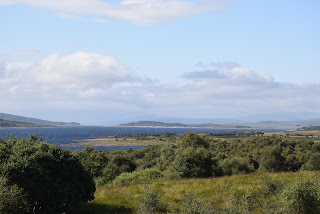
Over the Black Isle to Bonar Bridge then pushing up the centre of Scotland to Lairg and the shores of Loch Shin. 

I don’t do the “bucket list” thing. 

If I fancy it I’ll give it a go. 

I remember at a young age wondering what Niagara Falls were really like and why people were compelled to climb into barrels and go down the falls. Two years ago we visited and I am still none the wiser. 

Looking at map books in my formative years I scanned the top of Scotland and wondered why there were so few roads and how come some of those large bodies of water had no vehicular access. 

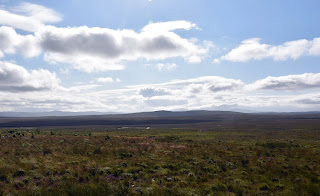
Pushing on past Lairg to Altneharra we entered what must be one of the remotest places we have ever visited, a vast peat bog with no houses, the road that I (and the map book) had as a “main road” for much of my lif,  was in fact a single track road no bigger than the Bransbury Lane with a few more passing places. 

The fact we were negotiating it in an eight metre long and three metre high Pantechnicon added a certain frisson to the afternoon.
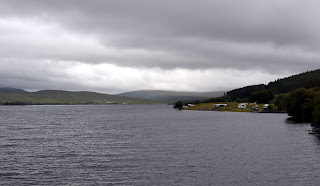
We pitched up on the shores of Loch Naver near Altneharra around tea time and tried to remember all that Ron and Roz had told us. 

The next supermarket was a couple of days away and we’d stocked up with essentials (mostly wine based) plus simple nourishment (mostly cheese based) . 

With both on board our minds cleared and we settled into what was a very comfortable motor home. I’d planned to flick a fly into Loch Naver but nothing much seemed to moving or hatching, even the notorious midges were absent. 

The Highland Clearances had a big impact on the area in the 1800s. We passed several informative boards on our evening amble that highlighted the injustices and misdemeanours of that period.
A leisurely rise and a mid morning departure on up the A836 which seemed to be getting smaller and smaller and higher and higher.
Progressing at speeds reaching close to thirty miles an hour we passed both Ben and Loch Loyal,
on to Loch Slaim
and down to the Kyle of Tongue.
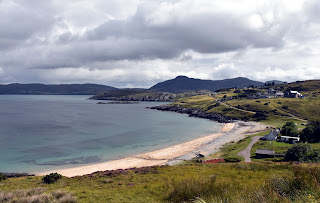
We were booked into a site on the beach in Talmine, sans electricity.
The Moho had batteries and gas that ensured the lights didn’t go out and the wine remained chilled for the twenty four hours we were there.
We’d entered the Kyle of Tongue the previous day in what I believe is termed locally as a “Dreach”
we departed in bright sunshine and a view of mountains that had remained hidden the previous day. 

Over the Naver, Borgie, Halladale and Thruso and several other rivers that screamed salmon and are beyond my budget when it comes to bothering brer Salar. 

We paused for a picnic lunch looking out to the Orkneys with “Old Stogies” to follow. Men of means by no means, we were indeed Kings of the Road.
Through Thurso and on to Dunnet Bay and a view of Dunnet Head which contentiously lays claim to be the northernmost point in Scotland.
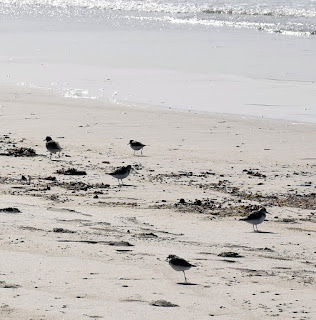
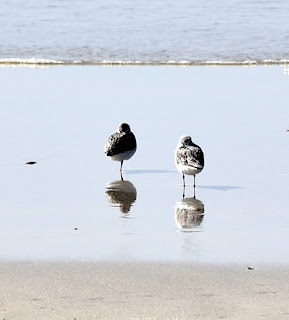
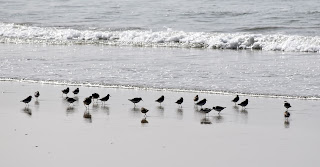
I had these little wadery types as Dunlin.  

There were other waders about, but these critters were the most entertaining. Look closely and you will note that the foremost Dunlin has only one leg.
While the bipedal Dunlin scuttle about the foreshore, the monoped bounced about on his/her single limb. He/she seemed fat enough and when they all took flight the negative impact of being one down in the leg department was neutralised. 

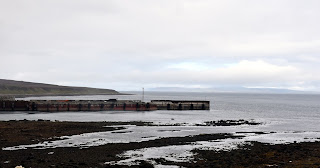
Heading further East in the morning, the Orkneys were occasionally absent as the Dreach returned. Briefly the clouds parted,
here’s the ferry terminal for the Orkneys, that’s them in the distance.

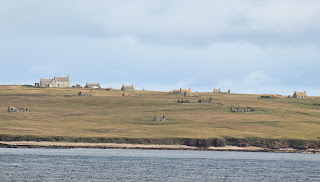
With the Dreach departed, the Isle of Stroma hove into view.
Inhabited until the 1960s, the abandoned crofts, church, cemetery and phone box could clearly be seen. The waters around Stroma are notoriously treacherous with whirlpools, tidal races and Sprites. Storms battering the north coast often sent seawater right across the island and the water supply to the locals varied in its salinity. Mostly crofters, the Stromanites (as they will now be known) also traded goods with the mainland. When a lighthouse was proposed to protect shipping and reduce wrecks, many Stromanites objected as, bounty washed up on the beach was a useful source. 

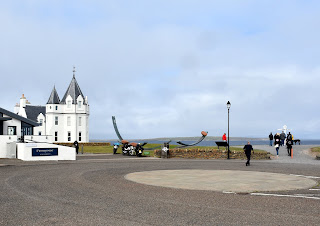
Popped into John O’Groats which was everything we anticipated and a bit of a circus.
We’ve touched the breast of Juliet in Verona and leaned into the tower of Pisa to have our photo taken (it’s on here somewhere) John O’Groats has a similar feel, with a plethora of gift shops peddling Tam O’Shanter hats with integral red hair and Loch Ness Monster Figurines. 

Heading south
we wandered into Wick to camp on the banks of the river where there were many Oyster Catchers.
I knew of Wick from a week fishing the bottom bits of the Deveron in my youth. 

For many years the Deveron was the furthest I had ventured into the Arctic Circle but each evening of our staynwe could see the lights of Wick twinkling in the distance, even further north than we were and what my fourteen year old self considered to be just short of the North Pole. 

Well Wick is Wick. It’s a fishing fleet town, a bit scruffy but host to a very good French restaurant where we ate that evening. 

On our penultimate day we covered the most miles. Just under a hundred in all. 

Past many Clan seats, this one may have something to do with Isla Sinclair, We don't know, nobody answered our knock on the door to answer our enquiries.
This is the highest point on the A99. There is a short section that is closed off when the snow falls, cutting off a corner of Scotland by road.
Dunrobin castle hove into view and we had almost completed the circle.
Lunch was taken by the bridge over the mouth of Dornach Firth. It features regularly on the traffic news and as we nibbled our dainties it quickly became clear why as our three metre high and eight metre long Moho wobbled in high wind. 

We spent our last night on the Black Isle. Fortrose to be precise. As the evening tide turned Bottlenose Dolphins performed along with some fairly sluggish seals.
Back to Ron and Roz the next morning and a flight back down to Heathrow. A tremendous trip that we both needed, if only to get moving again. 

We’ve both tested for the pox since our return and all came back negative. 

Oh yes, throughout our tour of one of the more remote corners of Europe we experienced a 4G mobile signal throughout and excellent internet connectivity. My parents who kindly held the fort at home, a few miles from what some would have as the greatest and most progressive city on earth had no internet throughout their stay. 

 Memo to “Our Great Leader”: You might want to revisit that “levelling up” thing that you promoted over the last few years in order to get something done.

Normal service will soon be resumed, a brief break has restored no end of vim, with vigour forecast sometime in the next few weeks.

Sunday, 25 July 2021

Ping! Woodcock and The Best Boy Ever

Ping! 

And as if by magic the shopkeeper appeared, 
Well that’s what I was brought up to believe would be the consequence of something going Ping! 

Seems ping is all the rage now (wasn’t he a penguin back in the day?) and my NHS Pando App has pinged me four times in the past few weeks only to ping me back to say that while I may have been close to someone carrying the pox there is no need for me to return to my cave for an unkempt ten day period so please press on regardless, 

What’s that all about? 

Have I achieved “keyworker” status?  

Anyway, apologies once again for tardiness with regard to chucking up guff but most of my days are currently spent cutting grass and pulling bindweed. I can get round the river banks and paths thorugh wood and meadow in around two days but currently once the task is completed its straight back round to the first bits to start again. If I sat down and looked (contrary to popular opinion, I rarely sit down) I swear I could see the stuff growing. One evening last week I announced to Madam that I was going out into the garden to pull a few weeds.
Two hours later I returned indoors having given battle with the forces of weeds various. The next morning the white flag was raised to convolvulus whose legions had massed in the night to once again carry the day. 

I’ll whisper it quietly but wellingtons remain the first choice of footwear for anglers flicking a fly into this stretch of the Dever. The July weedcut is now done, I tickled up a few bits of ranunculus and hacked away at the insidious ribbon weed, but not much more than that. Blanket weed is about but not in the mob handed way it has been in previous summers, and to extend the “sotto voce” tone of the piece, the river is running well. 
Fishing remains tricksy, but it is July and one would expect nothing less. 

At which point I”ll repeat the mantra “ one fish in July is worth four in May” 

Mantra done 

There are sedge about and a trickle of olives but during the day many fish are now preoccupied with a sub surface menu of gammarus and nymphs various. 

And so to the register, 

John Woodcock, the esteemed cricket correspondent for The Times who died aged 94 last week was someone I had known for nearly thirty years.

He fished at Bransbury and brought unruly spaniels to beat on our small shoot many times. He had a rod on the middle Avon at Woodford and took me over there as a guest on numerous occasions. He had a great depth of knowledge of the chalkstream environment and my description of the Test being too polite to flood is directly attributable to himself. 

Up until last year he was a regular presence on the boundary at Longparish CC on match day, copy of the The Times in hand, chatting away with a procession of lurkers keen to make the aquantence of "The Sage of Longaprish", before moving on to the The Cricketers or Plough for a pint and further discourse with locals. 
Following success in the Village Cup Competion in the eighties, of which John was immensely proud, the club experienced a period of decline before rising like said phoenix from said ashes to once again climb the Hampshire League ladder in the new millennium. John was ever present on the boundary throughout. 
He was a smashing fella, Longparish through and through, and an entertaining chap to spend an hour or so with, be it on the boundary or in the pub. 
He was a great promoter of Child B's cricketing cause, who he insisted had swallowed the MCC handbook at an early age. Child B had several trials as an opening bat for Hampshire and on finally being selected to play for the county, declined the offer as he had an important Village Cup competition game for Longparish on that day, which speaks volumes for the atmosphere around around the club and also the Hants CC Colts County set up at the time.  

Longparish moved through to the next round of the compettion, Child B scored a hundred and all was well with the world. 

Hants U15 lost heavily to Surrey U15s. 

News Just In: Mariella Fostrup’s been on and requested spoken guff on John’s association with cricket at Longparish at 2.30pm for the “Life and Times” slot on Times Radio. 

And now the dog, 

This could be difficult. 
Otis has gone. 

Widely acknowledged as "the best boy ever" Otis has now exited stage left. 

Living to the great labrador age of 14 he now rests on the riverbank alongside the world’s worst spaniel and his uncle Zebo. He kind of fell apart at the end and the decision was not a difficult one.
As a working gun dog he was very good and excelled at picking up ducks in the dark but was probably shaded for the gold medal by his Uncle Zebo.

Socially he had impeccable manners with no side. 

By way of a Croft and Perry analogy, Zebo was a Captain Mainwairing who could be relied upon to deliver a “you stupid boy” look every time I missed a quacker. Otis was Sergeant Wilson writ through and exuded “my dear that’s a very pretty dress your wearing” 
Now we’re stuck with the private Pike that is Moss who will miss his Uncle Arthur. 

He was a dog that was comfortable in any environment. He travelled on trains, the tube, the bus and several escalators. He lay in the church aisle at two funerals, stayed with us in pubs and hotels and considered the score box at Longparish Cricket Club his personal domain. 

He will be missed by many but not forgotten.

What a dog, we were very lucky to have you along for the ride.