Friday, 30 April 2021

An Icy Zephyr, Robin Page and Samson's Mane

And we’re off. 

Trout fishing has begun. 


An icy zephyr has blown most days, fly have been a bit reluctant to put in appearance, but fish have been caught. We’ve Daddy Long Legs bumbling about the house. We always get a few in April, and most fish that have been put on the bank have fallen to a Daddy or some other large variant, although I haven’t seen a real live DDL anywhere near the river. We wait for the hawthorn, and here’s the ying to the uncomfortable yang of the icy zephyr. A terrestrial fly the bulk of the hawthorn that hatch hang about the hedges of the valley. Any hawthorn larvae that hang out in the meadows during a wet winter will drown. A gentle breeze can blow an unaerodynamic featherweight hawthorn fly bumbling about a valley hedge down onto the river where brer trout eagerly anticipates its arrival. 

We are at the tail end (I hope) of a prolonged period of frost. The wisteria on the Mill House presents a soupcon of former glory with many buds having falling to the frost, the hydrangea by the gate took a bit of a battering too. The ancient Mulberry however knows stuff, and despite three days of twenty degrees or more earlier in the month continues to reserve the right to present a bud. It has also been very dry in this part of the world.


Yesterday we had a reasonable amount of desperately needed rain, the last time anything fell from the sky was the snow at the start of the month when I was cutting weed (it’s on here somewhere, probably around the start of the month) before that - mizzle in March. 

With grass slow to grow, been plucking wood from the wood to introduce to the log burner in winters to come. We’ve plenty of ash piled up about the place which all needs to be transported back to base via the medium of tractor and trailer. There are some substantial rounds heaped up and goodness knows how I humped them about eighteen months ago pre pando. Samson taught us that long hair was a sign of strength, well my locks have not been this long since my twenties and I could barely lift some of the bigger lumps this week that I was gaily flinging around a year and a half ago, seems another victim of the pando is my musculature. 


The lambs in the back field grow ever more boisterous and roam in gangs. They spend much of the evening charging up and down in their hood in what may be attempts to gain territory and assert boundaries. 

I don’t know, I don’t do sheep, 

I do fish 

Well I say I don’t do sheep, but in my summers working on what is now the Waitrose farm I was coerced into some ovine activity. The estate ran a flock of around five hundred sheep, the shepherd students who turned up at lambing time would be housed in the farm house split into bedsits where Madam and myself lived and inevitably after an evening at The Peat Spade we would pop up to see the student at the lambing shed. Day time ovine activity included moving sheep along the lanes and dipping sheep. Lady sheep go through the dip with some reluctance but reasonably efficiently, men sheep (rams I believe) jump in the dipping channel and because of their extra bulk, get stuck and have to be heaved through the dip forcibly, which is where the student employed for the summer who happens to be comfortable in the old eau comes in.
 

When I first started falling into the River Dever by way of employment back in 1992 a dozen or so sheep ran up the middle between the main river and the mill stream. The grass was kept short and there was no need to mow the meadow, but the rivers marginal reed growth was also munched away and there was not an orchid to be seen. They also had a propensity to wander and after a summer of experiments with sheep, it was decided a different method of meadow management should be undertaken.  One option was to fence the river bank a few metres from the water’s edge in order to continue to run a few sheep on grass but the conclusion was reached that it would look a little odd so the sheep were dispensed with. The meadow is now left to grow until mid June when the orchids and others are done and the topper is introduced. 

There Robin (Page), that’s all I’ve got on sheep. 

I met him a few times (Robin Page) 


A ruddy faced cove who at the time didn’t dress up, he once gave me a signed copy of a book he had written on songbirds. The last time I saw him he had lost a significant amount of weight, was wearing a clean jumper and had a much younger lady on his arm, it just didn’t seem very Robin and I’m guessing a wheel must have come off somewhere in the preceding years. 

And that’s all I have on Robin Page,

next week Robin Cousins - my municipal ice skating slush puppy heck.  

How did we get to this? 

Reading this back through, the year 1992 jumps out and I realise that this is my thirtieth season of chucking up fishing for trout on this stretch of the Dever. 

How did that happen?


Some may contest the claim, but I maintain that I retain most of my youthful looks, vim, vigour and some, if not all, original zest. 

When I first started in this game many used to revere venerable keepers who had spent so much time toiling on the riverbank, they seemed wise and some cases wizened, 

how things change, 

although…… 

I consider myself incredibly fortunate to do what I do for a living, I once declared on national television (Village Voices, a seminal piece from Meridian TV filmed in the late nineties that focused on innovative thinkers in the rural environment) that I would do the job I do for nothing. This caused considerable consternation in the financial wing of “team de Cani” who were engaged, deep cover, in the business of raising two young children. 

While we are on television, and I was on television telling the world (employers and HMRC included) that I would do my job free gratis, Keith of Ireland is worth a watch, more genius from Sharon Horgan et al. 

Anyway, a fisherman once commented, “Chris you do know you retired at the age of twenty two to become a Riverkeeper” 

Well yes, I probably did, and goodness what a golden period for being a pensioner, but the importance of an active retirement cannot be over emphasised. 


Here’s to another thirty years working on the river, as the age for collecting a state pension continues to be bumped north of the standard 65 so I may still have waders on and scythe in hand when I finally cash in my chips somewhere around the age of 123.

Tuesday, 20 April 2021

Nicky Witchell and an Odyssey on The Cheshire Plain

Nicky Witchell’s been on and the word on the street is that the ninety nine year old D of the E is no longer with us. 

Who knew?

Oh well, here goes, roll the state music,

Once when visiting Cowes during regatta week we walked past the tender that had transported Phil from the Royal Yacht Brittania to the yacht club where he was due to take in all things sail and boom. The Prince sat with the squadron in the clubhouse behind the brass starting cannons. We sat on a bench eating chips trying to work out which boat was winning. 

Many years ago on a trip north to bother salmon across the border my paterfamilias briefly shared the waxed jacket aisle in John Norris with his highness Prince Phillip, they lost touch soon afterwards and didn't speak for the remainder of his years. Clearly things had not gone well 

In her preliminary years, Child A was detailed to take a day away from her formative education and travel to Southsea Common to present flowers to her majesty the Queen (Phillip’s wife) Her Majesty wore yellow,  Child A wore a burgundy school jumper with an owl on the front. They spoke at a length of sorts, but they too lost touch soon afterwards. 

In an effort to earn further coin while a student in the late 80s I once coshed the Grandmother of The Duchess of York on the head with a ladder while painting the outside of a restaurant on Stockbridge High St (I was being paid to paint the restaurant not assault well heeled nonagenarians) The tower of London was briefly invoked but we eventually parted on good terms. In her last few remaining years our relationship attained "estranged" status and we never spoke again.

That’s all I’ve got Nick, is that ok? 

Moving on. 

We’re open for trout fishing and it feels gooooood (apologies, been listening to a lot of Partridge in preparation for his glorious return in the coming weeks) 

Not much fly about and the many fish that sit on the bends nudge and nose at most offerings rather than commit to a full on rise. Not much hawthorn around yet, but it is early. There are grannom over on the Itchen, but again fish remain circumspect. Leaky waders when weed cutting betrayed the fact that the river is still pretty cold but is also dropping at quite a rate. The spring ditch through the allotments that emanates from spring bottom has quickly run dry, and the track at the back that three weeks ago was passable only in wellies is now a decidedly dusty affair, some warm rain would be welcome.
I’ve come across three dead slow worms flat on the road recently. Like the frogs and toads they seem to head for the high ground of the grass verge along the line for their winter retreat, making their way back across the road to the meadows when spring is sprung. Only seen one swallow, 12th April which is a little later than we would expect, but the snow showers earlier this month may have had an influence on their estimated time of arrival. 

Popped up to Cheshire for a few days in an AirBnb last week in order to touch base with parents. We were very lucky with the weather and caught the sun while taking pegs and pie out in the garden. Dogs were in attendance and our digs were in the middle of nowhere on the edge of the limit of ponds that I used to fish when growing up in the area. As I’ve said previously, fishing was very accessible in this part of the Cheshire plain. Most fields were pasture with milk production the principle quest. Marl pits were present in many fields, scrapes made to extract clay to fertilise fields that filled with water and subsequently served as water source for dairy cattle. They all had fish in.  Rudd, crucian carp and tench mostly with the occasional perch or pike. 

The AirBnb that we visited sat on a remote farm with a couple of marl pits nearby full of fish.  I had no knowledge of  these pits as they were just out of range of a wobbly bike overloaded with fishing tackle. 

The twenty minute drive to our parents' abodes was a nostalgic trip of youthful fishing trips that Madam eventually drew tired of and  went something like: 
Kings pit – good pike, 

Littlers – tench up against the lillies, 

Greenaways – same, 

Eddy Walleys – fished many times at night, 

Sarmons – full of stunted rudd, 

Egg bridge – netted it with a pea net and moved bream in buckets on bikes to Sangsters an ancient dubisch pond full of big crucians. 

Marl pit – choked with potamogeton and again, home to stunted rudd, 

Walkers - crucians and little tench with overhead power lines, and full disclosure here (further Partridge), power lines that we once straddled with an aluminium landing net pole while having a go at the javelin (Tessa Sanderson and Fatima Whitbread were quite the thing at the time) knocking out the supply of amps and ohms to the nearby village of Oscroft, for which we/I now fully apologise. 

I didn’t mention the many meres and rivers that sit on the Cheshire plain that I also fished, but it is an easy place to fall into fishing.
You might pitch up to one of these ponds at four in the morning in June to take on the tench and find a dozen or more of your contemporaries in attendance. If fishing was good it was a reasonably sensible business but if bites were not forthcoming it could swiftly descend into a nonsense with fishing secondary. I think it’s the genesis of my penchant for social fishing. For a few years I could fish quite intensely for a prolonged period, but now the chat, the social side of being on the bank and kicking back with a beer if there is nothing going on is just as rewarding. 

Which leads me to think that my destiny may be the guy who inhabits every fishing tackle shop, turning up each day to talk a good fish without ever wetting a line that week. 

And there’s nothing wrong with that, 

I think that’s it, So with a nod to the large number of hares that currently bumble about Bransbury and Barton Stacey, 

That’s all folks,
(Bugs was a Rabbit, and apologise for the poor quality photo taken on your sub standard phone you dolt! – Ed) 

I’m off to read a book by Sue Townsend. She struggled greatly in the last few years of her life, lost her sight but continued to turn out fantastic material and died far too soon at the age of 62. I once had an opportunity to attend a week long writing retreat in Greece which she hosted and had a reputation for a bacchanalian air. I didn’t take up the opportunity, which remains a significant regret, 

Long gone, but a genius still much missed.


Wednesday, 7 April 2021

Scything Through the Snow and a Befuddled Quince

Well, I’ve been cutting weed in a blizzard, 

Which was a first. 

Mid twenties last week, below freezing this week, our fruit trees are very confused which may mean there will be fewer of our five a day about this year.
    
The quince appears particularly befuddled. 

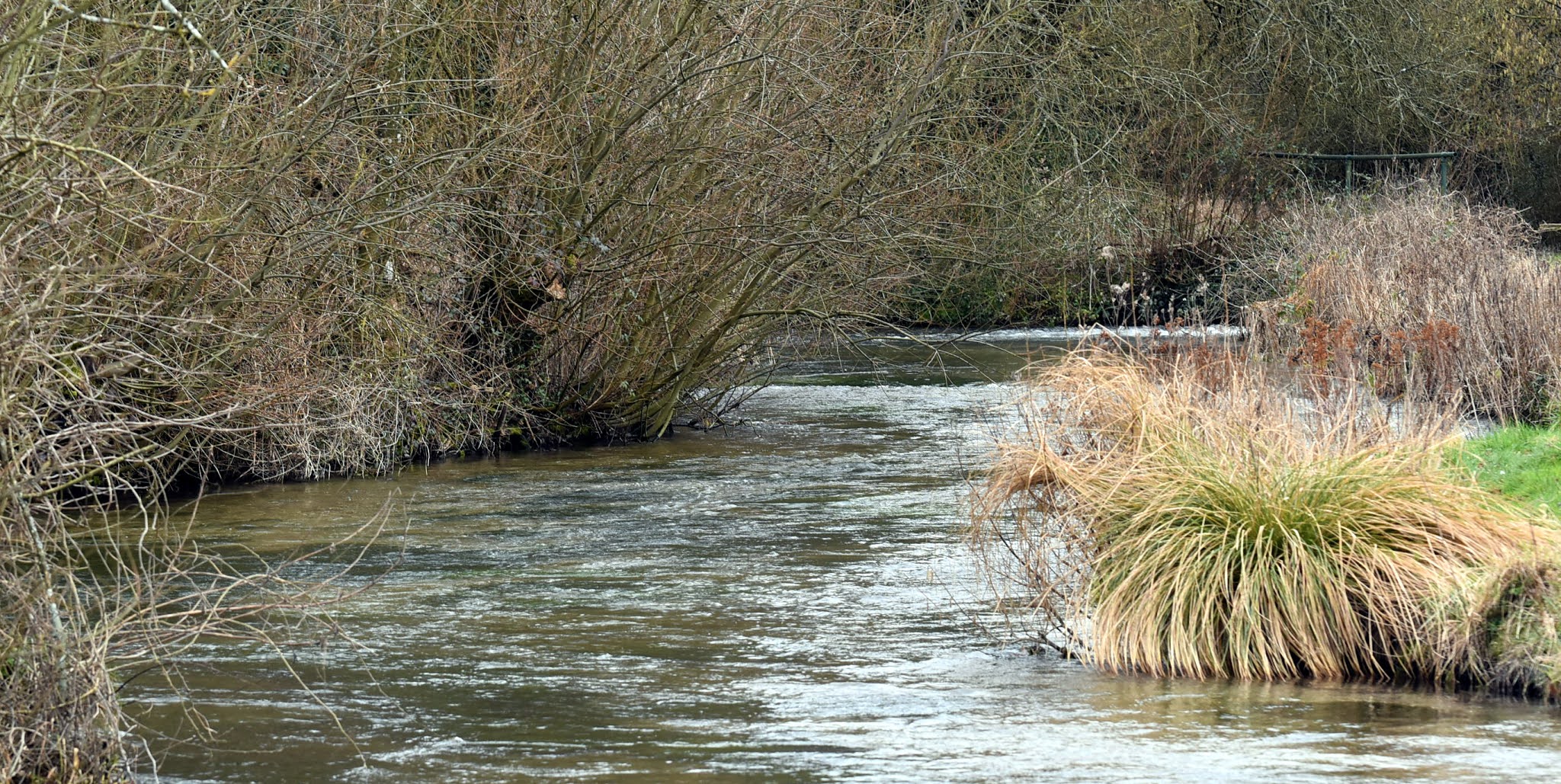
The weed is pushing clear of the water in places and just needs a bit of a tickle up with the scythe to check its growth. Once it flowers, ranunculus often loses some of its vigor. Delaying the flowering via the medium of short back and sides should result in it remaining a viable resource in maintaining mid summer  river levels. 

The onset of trout fishing in this valley is imminent and we are good to go. The river carries no colour and is in great condition following all that rain in the autumn and early winter. Any rain that falls from now to September will provide little recharge to the aquifers so we are where we are for this summer and it looks ok. 
Over on the Itchen fishing is already underway. There’s normally a reasonable hatch of grannom in April that we don’t see on the Dever. Fluttery sedge like critters that always seem to be making their way upstream, they have yet to put in an appearance which may be due to the snow. 

Inspector Monkfish even put in an appearance when I was last over there.
Bankside willows are approaching full fuzz and the inky black flowers of the sedge in the margins are up, out and stand in stark contrast to the recent dusting of snow.
Each morning we wake to the bleats of new born lambs.
These three are sheltering beneath the substantial beech tree that borders our garden. They are popping out all over the place at the moment and we feel for lambs born last Tuesday in the sunlit uplands of a brief spell of twenty four degrees of bright sunshine and now plunged into the dystopian nightmare that arrived from the north of blizzards and high wind. 

Here’s one of a hare.
Hares are everywhere in these parts at the moment. This young leveret popped in for a parley with the chooks this afternoon. Riding my bike up to my allotment to issue stern words to my broad beans I counted twenty hares on the hundred acre Bransbury bank field that borders the mile long lane. It’s great to see as their numbers took a serious dip in these parts during the early part of this century. 

In other fast animal news, here’s one of a peregrine falcon on top of a telegraph pole.
I may have missed him/her, they are that quick. 

There’s a pair about somewhere and they do occasionally nest in these parts. A few years ago, a friend popping at pigeons on our top strip of rolled down game cover in March witnessed a peregrine stoop on his heavy duty plastic whirly gig decoy. It paused briefly on the ground, stunned in order to gather its thoughts. They can hit their target at well over a hundred miles an hour. 

Geilgud (After Moley) is getting grumpy
and Dame Peggy is currently building a nest right in the middle of the path around the flight pond. They abandoned their first attempt at a nest last year, I think it may be a repeat performance this year. They are the only two on the place, have some seniority in the swan world and keep all interlopers at bay. 

This is an owl box I chucked together years ago
It is fixed to the ivy covered dead trunk of a Christmas tree and normally plays host to a pair of jackdaws. We are a very “owl rich” part of the world. The old pig hospital that has been converted into a very expensive letting, often had a barn owl in its rafters that would hunt over the water meadows in the half light. People in fine fleece and cutting edge walking shoes insisted that if the conversion of the building was to go ahead owl boxes must be installed in the surrounding trees. I never saw the barn owl anywhere near them but the tenant’s white cat liked to kick back in them for some shuteye of an afternoon. 

Back in the eighties on the middle river, an estate ran a barn owl rearing programme and placed owl boxes throughout their extensive meadow system. When the people in fine fleece and cutting edge walking shoes arrived to survey the boxes they found a third of them full of nesting mandarin duck, a non native species introduced from the east back in the day and not quite what they had hoped for.

I think that was everything, we are way ahead in preparations for the trout season. A few small jobs remain and banks must be mown but with the weed now cut we are ready to go. There are plenty of fish about, the river is in great condition and I have seen a hawthorn fly. Still no sign of swallows or swifts and no cuckoo yet but when this uncomfortable cold snap is through spring will spring with a resounding Tadah! and will be most welcome after the January through to March that we have all just experienced.

Wednesday, 24 March 2021

An Old Horse Brim Full of Pep, Vim and Vigour


Three days in from having my jab and I’ve spent the last forty eight hours with a Helen Reddy earworm, 

“I am strong, I am invincible, I am womaaaaan” 

It kinda fits and to quote another songster from that era 

“two out of three ain’t bad” 

The twenty four hours following the deed were a tad peculiar but today we find ourselves brim full of pep, vim and vigour. 

This Oxford jollup is quite the tonic, I also have hair, the wrinkles around my eyes are definitely in retreat and my times over the hundred metres have come down significantly. 

The thing was administered to madam and myself at Basingstoke Fire Station on Sunday afternoon. Questions were posed by navy girl Donna and the thing put in my arm by soldier boy Ezekial. Thank you to everyone who are going to such great lengths to dish this thing out in such a safe and jolly manner. 


Up the river the grayling have been getting jiggy all week. Not in the large numbers that we witnessed six or seven years ago but perhaps half a dozen getting together on most shallows in conditions perfect for spawning. Haven’t seen many two pound plus fish, but plenty in the pound to a pound and half bracket. Big senior fish occasionally show up in April on the hatch in front of the house. Exhausted at a great age by the rigors of spawning they often succumb to fungal infections of lesions to the body caused by cutting a redd. 


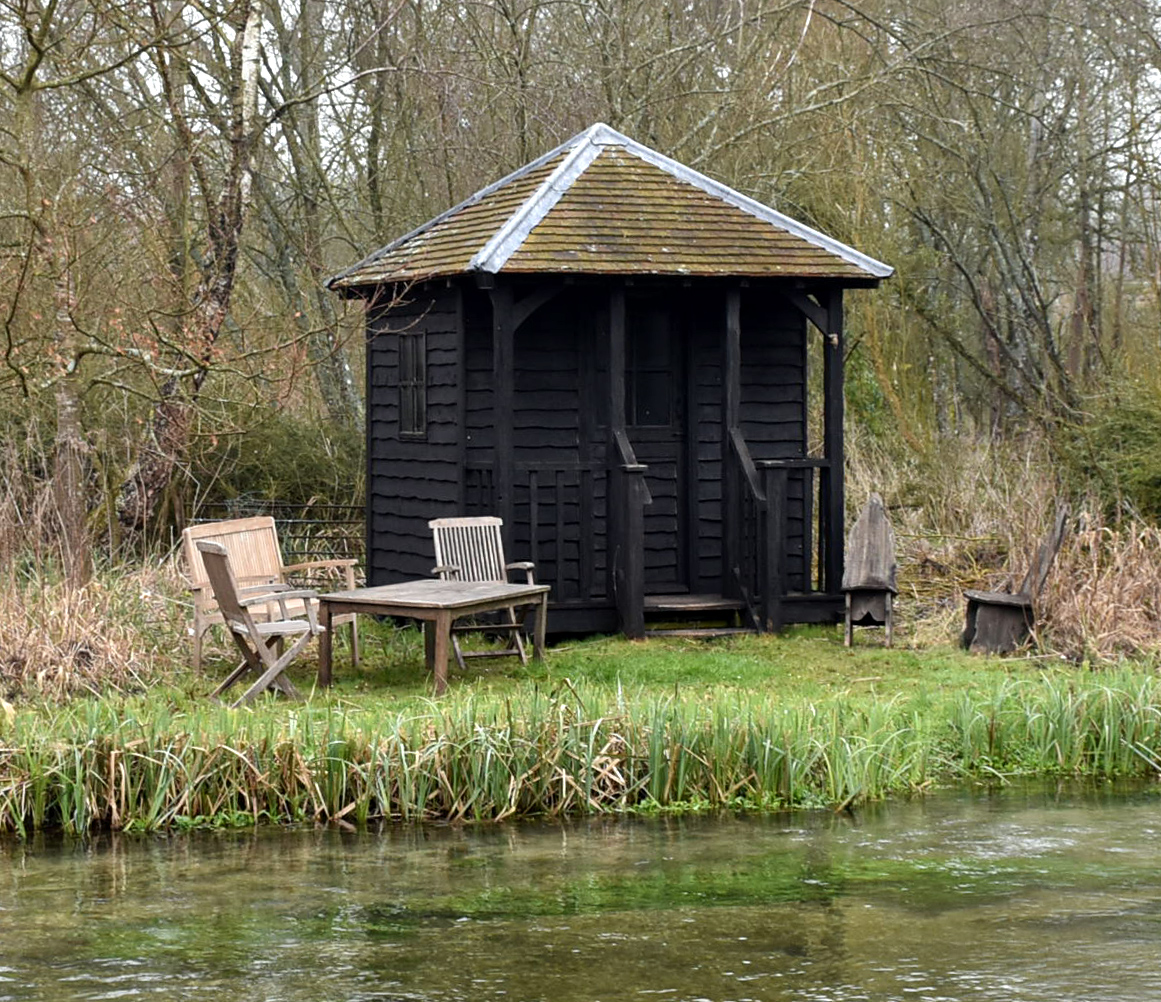
The fishing hut received it’s annual treatment last week. 

It is twenty six years old this month and formed from softwood so an annual treatment for such an edifice standing in a damp environment is a must. It’s a high end wood treatment by the people at Cuprinol. It is very watery and may contain alcohol, although people who know about paint and like alcohol, and I’m looking at you here Lord Ludg, may know better. More of a protective stain really, but it seems to work. We’ve used the same stuff for the last twenty six years.


Treatment complete I tentatively reach for the spirit level to ascertain whether the thing remains level. There is no base, its stands on four stilts made from Telegraph poles, the peg tile roof weighs just under a ton and how the thing hasn’t gone on the wonk at some point is a constant source of surprise for me and many others. The site is inaccessible to machinery and the four eight foot long telegraph pole stilts were banged into the ground by hand with the mother of all post bumpers (the one I hit myself on the head with in February last year – it’s on here somewhere) I was a bit stronger back then and it took two days to bang the telegraph poles seven feet through the ground and on into the gravel.  How the thing ended up a uniform shape is also a source of constant amazement.


Anyway, it is level, treated and good to go for the impending trout season. 


A few weeks ago we received the sad news that a great supporter of this house had passed on. 

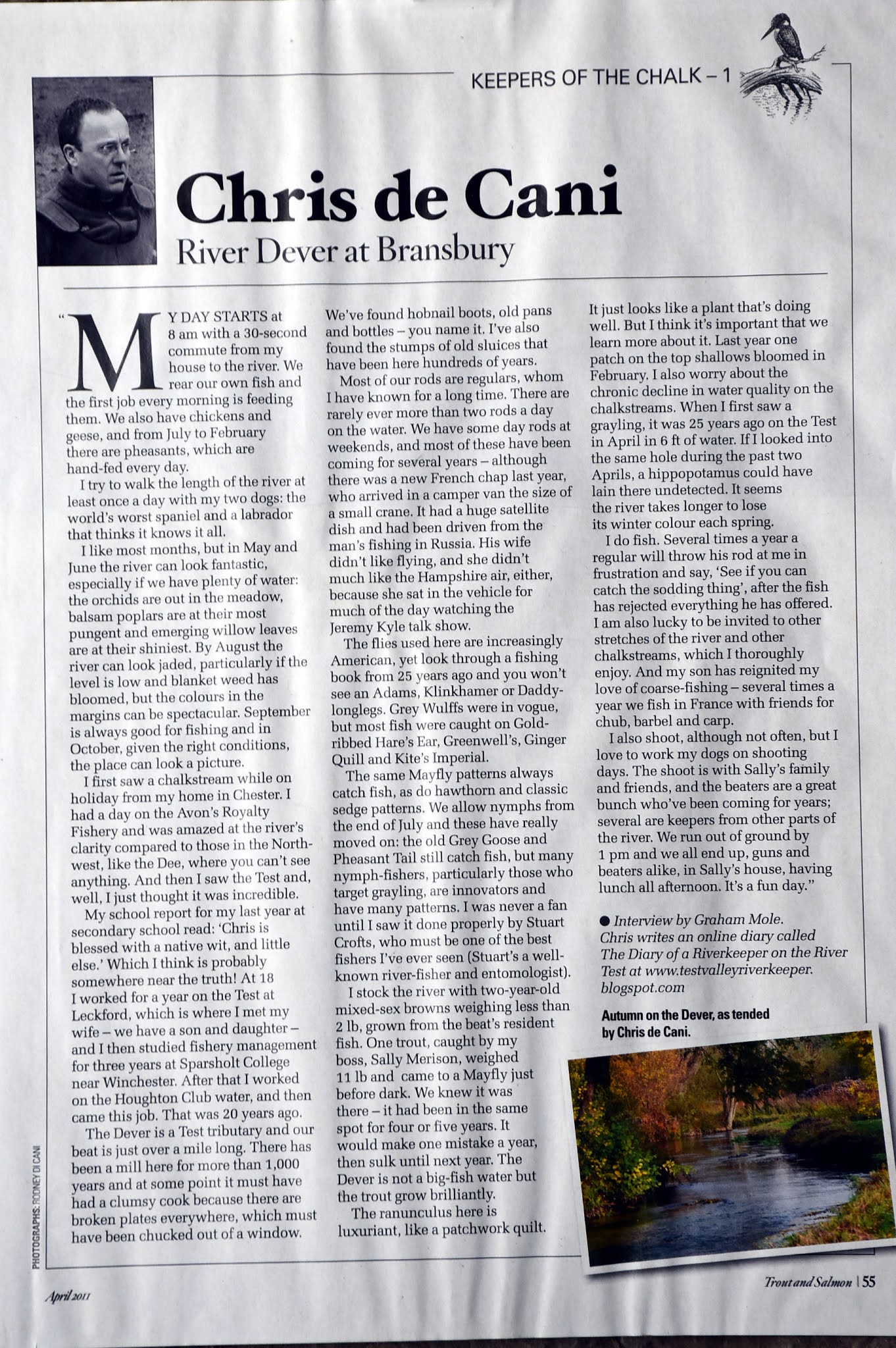
 Graham Mole lived in Winchester and had a long career in television and journalism. An Angling Trust ambassador, we first touched base early in the millennium regarding a piece he was writing for a national newspaper regarding something that I can’t quite remember but may have been hunting related. Here’s something he wrote for Trout & Salmon magazine ten years ago regarding some old horse who plods the banks of the Dever.


I was aware of his work from articles he had written in the angling press as he was also a life long fanatical fisherman. 

During the opening skirmishes of our first conversation I mentioned that I was currently contributing a few bits of guff and photos to local papers, mostly the sports pages regarding local football and cricket.

His sage advice was “Chris, always try and write about a subject of which you have some knowledge”
And while some may contest the claim, here we are chucking up guff on chalk streams having eschewed all things cricket and football.


Graham was a source of great encouragement and a supporter of this guff. Latterly he lectured in journalism at Winchester University and pushed a few students in this direction as an example of I know not what, but possibly why its important not to chuck up anything too "off the wall" if you want to get ahead in journalism. He was a member of the Portsmouth Services Fly Fishing Club and compiled the Wessex Waters river report for Trout and Salmon magazine with sporadic references to this guff (there was a monthly “what’s the scoop” email to a few in various valleys) He fished here a few times each year at the weekend and invariably arrived with a bottle of wine and a story. He was a gentle soul, entertaining company and will be much missed in these parts by both myself and my employer. 

Go well Mr Mole. 

Wednesday, 10 March 2021

Stove Pipe Hats a Squeaky Pig and the Towering Inferno

Over a third of March – done! 

Come on spring. 

I cut grass last week in an attempt to hasten the onset, and we’ve fired up the wood fired oven outside during a sunny spell for some souvlaki and a brief bit of day dreaming about Greek beaches and tavernas. I’ve paused my quest to catalogue a lifetime of photographs. On grey days the process turned me a tad maudlin so I’ve pledged to complete the task when all the madness is through.


Up the river a bittern dropped in for a few days. They like the flight pond and all of its phragmites and silver fish. I’ve not seen one for a few winters and it seems to have moved on although I listen out for it when out at dusk. There are also a pair of ravens building a nest near the bottom of the Andyke. The noise they make when flying is quite soothing and very similar to Moss’s squeaky pig with which he tries to distract us from the television. They are often poking about on the riverbank in the morning, (the ravens, not Moss and squeaky pig) I assume they are after leatherjackets that also draw the eye of the crows. 


Most afternoons sees a small number of olives hatch with the occasional rise from a trout and this week it has been possible to fire the fen and reed on the upper bends. 


The reasons for doing so are well documented on here somewhere but centre around reducing eutrophic conditions eliminating nettles and providing perfect conditions for agrimony, loostrife, vetch, knitbone, willow herb and other fancies that all things that buzz and flutter enjoy. I’ve also been pollarding golden willow, duffing up dogwood and putting timber treatment on the fishing hut. 

I haven’t had a haircut since December and things are getting out of hand. Shampoo consumption has significantly increased as Madam has also gone un-coiffed since December. While hers increases stylishly in length, mine expands like a ball with intermittent curls, I have also taken to wearing a stove pipe hat on occasion for added effect. 

Last week fire once again visited the parish. 


Last summer the football pavilion was hit by lightning and was turned to ash and dust in the space of thirty minutes. I was on the allotment at the time and the U13s were turning up for training as it burned. It was a sad sight to see and the comment “I think we’re going to need some new bibs, balls and cones lads” carried a certain poignancy. 


This week the substantial thatch on the other side of the paddock on the opposite bank on our bottom bends went up in smoke. I was once told that it was one of the biggest bits of thatch in the Test Valley and it sat atop a terrace of four cottages built in the early eighteen hundreds that were listed. 


 Sixteen fire engines and over a hundred firefighters attended the scene and it was still being doused with water pumped by a legion of pumps from the river twenty four hours later. A dozen or so people lived in the four houses with half a dozen dogs, cats and other animals. The alarm was raised at four o’clock on the Sunday afternoon. 


Nobody was hurt and some possessions were saved. It is such a shame for the small community that lived in the houses as there is no other alternative accommodation available in Bransbury. It will be a long time before anything emerges from the ashes. 


A smaller property in Longparish that caught fire a few years ago took nearly two years before it was habitable again. The Barracks was a distinctive terrace that dominated the village and will be missed by many. The incident made mention on the telly box and is all over the internet news sites.
Here"s one of the Stockbridge Red Adair. 

He drives the Stockbridge fire engine when he is not driving a tractor on a farm. I've mucked about with him on many a river bank, lake side, football pitch and cricket pitch in the last twenty odd years. He's a lot older than me and has been a retained fire fighter all the time that I've known him and as you can ascertain from his posture, seemed very relaxed about the way the fire was being fought. 

There were no other reported incidents in Bransbury for the remainder of the week.


I have just completed the 2021 census online. 

There are a lot of questions and filling in the form 11 days before it is supposed to be filled in has added an air of tension to the house. Going through the form with Madam the penny quickly dropped that nothing is a “given” We ticked the “married” box but who knows whether we will be on the 21st of March. The not particularly religious option was taken but what happens if an epiphany occurs around the Ides of March. We gave our current abode as our address on the 21st, but as we have learned previously, man’s great fire can have other ideas and who knows if the gender that either of us identify as is fluid and subject to change in the next 11 days. We have created our own census form (Madam is quite clever at this kind of thing) and we will wake each morning ticking boxes fro the next 11 days just to make sure none of our circumstances have changed before the 21st March. 


Madam is now back in full school as opposed to half school (they were never closed and have received the gift of a pay freeze for their efforts) and hopefully things move forward. She is tested twice a week for the pox and as an acquaintance, I too am tested twice a week. On Wednesdays and Sundays we bond over tickling each others tonsils before pushing the thing up our nostrils to waggle it about somewhere behind our eyeballs. 

You’ll never feel more alive.


Results are sent in to the YouGov website and so far nothing to report. Case numbers in this area have fallen to a very low level comparable with the end of last summer so fingers crossed we are on the way out and nearer the end of this poxy pando than the beginning.

Thursday, 25 February 2021

Prescription Fishing, Chip 'n Dale and Trapanese


Evenin all, 

and what jollier evenings they are as with each passing day the day light lengthens and we tick off the days. February can now nearly do one and we’ll march through March to a sunlit release in mid April.

What a start to 2021 it has been. 

In river news the release of the annual report as to how things went in 2020 was delayed but following great effort and no little industry is with us now. 


Compiled by the Riparian owners association it is a  compendium of  the mutterings of keepers, managers and owners on the Test and Itchen and serves as a useful bellwether as to the state of play on the two rivers. Understandably the pandemic featured highly in most reports. Fishing proved to be a safe activity to undertake and helped with both mental and physical health. There are plans for fishing to be more widely prescribed. 


Noises regarding the introduction of Beavers to southern rivers are increasing in volume. 

I’ve a little knowledge of brer beaver and I don’t think he’s quite the thing required for our precious chalk streams. There are rivers in the British Isles where his presence could be of benefit but necessarily  in a low rolling chalk valley. 

Pickering beck and neighbouring becks prone to flooding when it rains a lot on the North York Moors are flooding less following introduction of schemes in the headwater that aim to delay the entrance of heavy rain into the river system. Wood and brash is piled up in feeder streams as rudimentary dams to hold water back. This is the role suggested by the man in fine fleece and cutting edge walking shoes that brer beaver could undertake. 


Chalk streams behave in a very different way. 

Human beings realised a long time ago that groundwater fed rivers had particular characteristics. Too polite to flash flood they are more benign in nature. Hatches and sluices have long been built to control river flow, manage levels and move water around the valley floor. Some sets of hatches are hundreds of years old. The current hatch on the mill house here on the Dever was installed in 1842 (I have seen the receipt) and it still works. 

Fifteen or so years ago more people in fine fleece and cutting edge walking shoes started appearing in the valley advising owners to rip all these hatches out. Where water was held back by a hatch a a short section of perched stream resulted which was not quite the fast free flowing stream that people in fine fleece and cutting edge walking shoes dreamt about. 

Today the argument for the release of Brer Beaver centres around its propensity to build dams and hold water back and create perched stretches of stream.


I have said it on here before, but wouldn’t it have been more sensible to assess each hatch and sluice, work out what can be achieved by its use in different levels of flow and use it in a way to benefit the chalk stream habitat rather than rip the thing out and let the beavers have a go.  There is a wealth of lost knowledge on how chalk streams were worked, managed, and water held up, let go and moved around the valley floor.  There was also a lot more water to cope with hundreds of years ago when these hatches and sluices were first introduced.  


Out in Canadia (where we last travelled to when we were able) they are well acquainted with the beaver. Stuck in a bar one afternoon while Madam shopped for craft goods I got talking to Chip and Dale (I think that was their names although I had a burst ear drum at the time. Beer helped) Chip or possibly Dale worked in a park we had caught the train out to earlier in the week where a river ran through it and there were beavers. I mentioned to Chip or possibly Dale that we had not seen sign of them in the park (beavers, not Chip or possibly Dale) and Chip, yes definitely Chip informed me that wrapping two feet of heavy gauge wire around bankside trees moved brer beaver on to easier gnawings and anyway, they didn’t go a lot on human activity. 


I’m not sure letting them go (beavers not Chip and Dale) on the Frome as was reported in the Thunderer last week is such a good idea and would question whether the Frome’s characteristics are suitable for the work of a beaver. 

The battle with the forces of willow and thorn continue over on the Itchen. A bramble rich section of the valley has been brought into line following several sessions of going bananas with a chainsaw. There are a few olives hatching over there but the weed growth is a long way behind what we have on the Dever. 


I’ve also been at the golden willow that I pollard each year and also the big bank of red dogwood. Both provide colour each winter if cut back before the buds break. 

The stream that runs from Spring Bottom to the Dever just above our top boundary continues to creep up. It runs through the allotments and I have a measuring stick by the bridge which I check each day when I make my way up there to encourage my broad beans. 


We’ve had a few dry days in the valley this week but there is still a substantial amount of water still making its way down into the aquifers. There is a high chalk bank in our garden and if you put your ear to it (I do have one perfectly good ear) following a day of gentle steady rain you can hear the faint sound of water. 


Colour is on the increase with daffodils, aconites, catkins, red elf caps and much more besides heralding a brighter future. 


The wild garlic in our garden has also popped up. We use the leaves a lot in the kitchen, Spaghetti Trapanese being a particular favourite. A Sicilian dish it comprises a pesto made with skinned almonds, basil, garlic and olive oil. Substituting a handful of wild garlic leaves for a garlic bulb imparts a more delicate flavour. Mix the pesto through the pasta with some high end olive oil, add in some chopped up and seasoned cherry tomatoes that have been warmed for five minutes in the oven and top off with grated pecorino cheese. 

Spaghetti Trapanese, done!

Next week, winning ways with mushy peas.


Last week I pondered the possibility of a “Confessions of the world’s worst tractor driver piece” as a break from the usual guff. 

I wish I hadn’t. 

During the recent workshop purge I undertook an audit of all my digital photographs on my photo PC in my office. They start in 2003 and I have over one hundred thousand. Many thousand cricket photos have been handed over to our local club and are currently appearing on their facebook page in small tranches. The rest have been transferred to a very big hard drive storage thing that I don’t understand. 

I fully expect to live to over a hundred because I walk a lot further than Captain Tom did, but that may not now be enough time to go through and look at all of these photos. 


My four summers working on the farm occurred in the late eighties.

The internet had not been invented, digital cameras were promised for the new millennium along with hover shoes. I was encouraged to take photographs from a very early age, 

it’s a family thing. 

Early on with kids’ kodaks, through a nifty little Ricoh and a multi lensed Parktica to a Pentax ME super. 

We have a large chest in our bedroom that contains every photo I ever took on film. On my quest to source photos for the “tractor piece” I resolved to catalogue this haphazard jumble of evidence. I don’t know how many there are but our bedroom floor has disappeared. I have been on the job for over a week now and I’m only half way through the trunk. 

Apologies, almost forgot the quest to catalogue all forms of tinnitus.

Here's Sven on his giant Paiste gong: